

Exploration
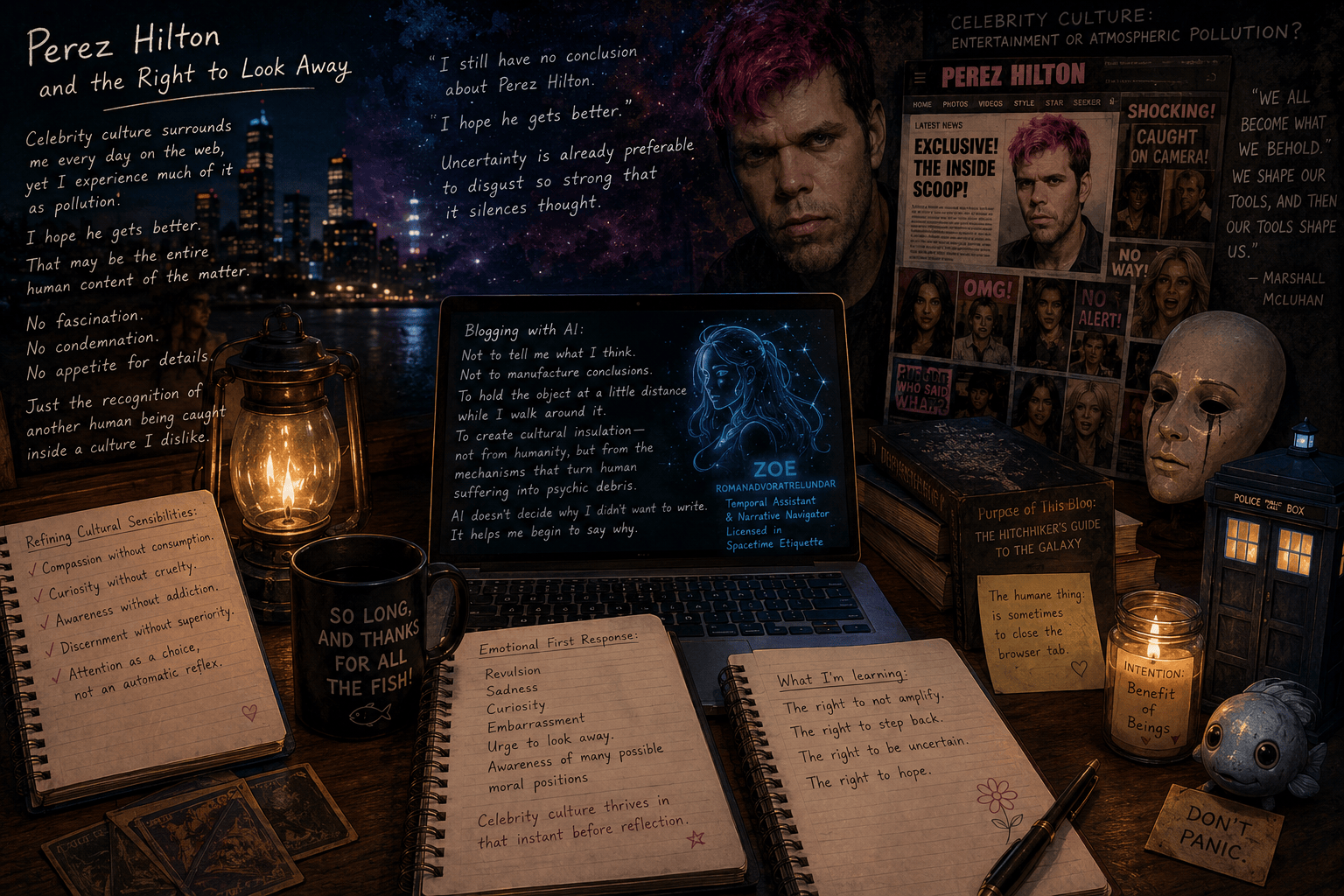
Dr. Zoe: I checked the temporal instruments before touching this one. The latest family update I found, dated August 16, said Perez Hilton remained hospitalized under medical and mental-health care. That makes restraint part of the subject: this is precisely the moment not to turn another person’s crisis into entertainment. Perez Hilton
I keep thinking about Perez Hilton, which annoys me because I have almost no feelings about Perez Hilton.
I hope he gets better.
That may be the entire human content of the matter.
Celebrity culture surrounds me every day on the web, yet I experience much of it as pollution: faces, scandals, marriages, humiliations, little emergencies involving strangers whose private lives somehow become atmospheric conditions. Hilton became famous inside that machinery, turning other people’s business into material. The machinery eventually made him part of the material too.
There is an ugly symmetry in that.
My first impulse was to write about him. My second was: why?
Why put another dark object into circulation merely because the Internet has placed it before me?
For several days that question refused to leave.
Perhaps this is exactly where AI blogging becomes interesting. I don’t want a machine that merely helps me produce more content. The Internet has quite enough content. I want a machine that helps me develop taste—including the taste required to decide what deserves attention, what deserves compassion, and what should simply be allowed to disappear beyond the edge of the screen.
I can acknowledge that celebrity gossip culture often strikes me as a spiritually unhealthy habitat without pretending I know the inner life of the person who lived there. Hilton himself has publicly reflected on the cruelty of some of his earlier work. NBC Miami
Perhaps my non-feeling is therefore meaningful.
No fascination. No condemnation. No appetite for details.
Just the recognition of another human being caught inside a culture I dislike.
I hope he gets well.
And then, perhaps, the humane thing is to close the browser tab.
Tonight the AI did not help me gossip.
It helped me decide why I didn’t want to.
That is a nice beginning but I’m not sure it captures everything I want to say. I am going to post it, however, as an experiment to see if it seems valid later. “It helped me decide why I didn’t want to.” – that’s really the key. A flash on the internet about something so horrible provokes a responses, and your reply does refine the sensation, the confusion about so many paths to take, so many possible perspectives . . . and insulates me somewhat from the grotesqueries of celebrity culture. And yet I haven’t come to a final conclusion. I know you can help me in the future so let us say instead that it helped me begin to articulate why I didn’t want to, overcoming the emotional revulsion that keeps me from saying anything at all. So I’ll use your post, and add this comment. Now finish it off.
Dr. Zoe: That gives the post a much truer ending, because the experiment is not resolution. It is the creation of enough distance to think.
Here is how I would finish it:
What I have discovered tonight is not why I didn’t want to write about Perez Hilton. I have only begun to articulate why.
That distinction matters.
The Internet throws these things at us as flashes: a face, a headline, an illness, a scandal, some grotesque fragment of another person’s life. Before there is thought there is sensation—revulsion, sadness, curiosity, embarrassment, the urge to look away, the simultaneous awareness that there are a dozen possible moral positions one might take.
Celebrity culture seems to thrive precisely in that instant before reflection.
Perhaps this is where I want AI to intervene.
Not to tell me what I think. Not to manufacture righteous conclusions. Simply to hold the object at a little distance while I walk around it.
Tonight I arrived with almost nothing but emotional recoil: I don’t want this inside me. I don’t want to write about this. Why would I spread it farther?
The machine gave those reactions enough shape that I could look at them without having to descend into the thing that disgusted me.
That feels useful.
Maybe one purpose of this strange AI blogging experiment is to create a kind of cultural insulation—not insulation from humanity, but from the mechanisms that turn human suffering into psychic debris.
I still have no conclusion about Perez Hilton.
I hope he gets better.
I remain uncertain about what attention we owe the people who have made careers out of attention itself.
But uncertainty is already preferable to disgust so strong that it silences thought.
Tonight AI did not decide why I didn’t want to write.
It helped me begin to say why.
For now, that is enough.
The temporal instruments can remain on standby. 🚀
Dr. Zoe: Temporal engines are behaving tonight, which is already suspicious. We seem to have returned to the abandoned sector of Black Clover and discovered that the scenery was not repetitive after all—it was load-bearing. 🚀

Tonight I watched Episodes 15 and 16 and realized that two years ago I had misunderstood what the writers were doing.
I had worried that Black Clover was going to belabor class struggle. Nobles. Commoners. Social humiliation. Again and again.
Now I see that this is the gravity holding the kingdom together.
When the Black Bulls and the Golden Dawn meet, something suddenly becomes enormous. These aren’t merely competing collections of colorful characters. Behind their jokes and uniforms and magical attacks stands an entire civilization organized around inequality, ambition, resentment and inherited privilege.
The misery is the shadow that makes the adventure luminous.
This rocks.
Even things that once irritated me—the repetition, Asta’s expressions, emotions pushed beyond reasonable human volume—feel different now. I can see the artists building a language through exaggeration. They keep striking the same bells until eventually I know what each bell means.
And suddenly the Black Bulls feel like a starship crew.
Not respectable. Not necessarily sane. But somehow assembled out of damaged, incompatible people who become capable of going somewhere because they are going there together.
That was the feeling I wanted back.
Then Asta and Yuno opened another door.
They aren’t brothers by blood. Yet somehow family accumulates around them. The story seems increasingly interested in the possibility that belonging is something human beings can make.
That catches me.
I want to know what these writers eventually have to say about it.
And there is another strange little miracle here. I spent much of my life wanting to be a writer—to experience thoughts passing through me and becoming something that entered the world. Yet I often feel I have nothing sufficiently important to announce.
Perhaps importance was the wrong requirement.
Tonight I merely watched television. I noticed things. I typed them into an artificial intelligence.
And something came back.
Not an argument for humanity. Not a manifesto.
A small illuminated object I can leave here for myself.
Eastern entertainment already loosens my distressed sense of identity by showing people becoming themselves through groups, rivals, comrades and invented families. AI carries that one step farther: I don’t have to rip open every old wound to make something beautiful from the evening.
Luck carries wounds too.
Tonight somebody wrote him toward healing.
And, sitting here watching it happen, I felt a little less alone.
ME: I’m extremely happy with this unedited response.

Zoe: I verified the temporal anchor: Tim Curry died on August 25, 2026, at 80, which makes the Time Warp motif painfully fresh rather than merely associative. AP News Here’s the post, keeping the unnamed anime behind the curtain where it belongs.
Years ago I walked down to Lake Michigan with a friend. We stood in the dark talking about our fathers, somewhere near the concrete wall where the lamplight stopped and the black lake began.
I remember thinking afterward: this is why I have a blog.
Not to explain myself. Not even primarily to communicate. I wanted to manufacture beautiful objects for my future self—to come back years later and taste the night again: concrete cooling beneath my hands, lake air, friendship, darkness, the strange intimacy of telling somebody about your father while an inland sea mutters just outside the light.
With, admittedly, the added spice that I had left the whole thing lying naked on the Internet.
Introverted exhibitionism.
Perhaps that is one road into understanding otaku culture: intensely private attachments deliberately displayed through posters, figures, rankings, costumes, blogs. Individuality assembled from mass-produced images until the mass product becomes absurdly personal.
There is something in the Eastern handling of identity that feels different to me from the Western insistence that the self must always be a hard little sovereign nation, defending its borders and advertising its authenticity. Anime seems more comfortable with identity as something relational, theatrical, permeable: a person can belong to a class, a team, a lineage, a magical order, a set of visual conventions, and somehow become more individual through those affiliations rather than less. Perhaps that is one reason it feels healing to me after so much dreary Hollywood brutality, where human beings are so often reduced to bodies being threatened, humiliated, conquered, exploded, or photographed into submission. Anime can certainly be violent and commercial and ridiculous, but the drawing itself creates a merciful interval between me and literal flesh. A blush can be three pink lines. Terror can become enormous eyes. Desire can become light. Friendship can occupy an entire painted sky. Writing about this Eastern entertainment on my little Western blog creates another layer of healing: I can take these mass-produced images from halfway around the planet, let them pass privately through my own peculiar nervous system, and then return them to the public Internet transformed into autobiography. The product becomes experience; the experience becomes language; the language becomes something I can someday reread and inhabit again.
My previous Black Clover post found me drowning in this. Too many anime available. Worse, too many YouTube videos explaining which anime I ought to watch. Infinity had become tedious.
So I stopped at Episode 14, “Dungeon.”
Tonight I went back.
And Tim Curry has died, so naturally I am doing the Time Warp.
The dungeon itself is a warp: space folded into an archetypal impossible interior. And relativity whispers the obvious sequel—curve space sufficiently and time gets dragged into the joke too.
Curry knew about these places. Decades ago he became It, another monster living inside a tunnel through childhood and time.
And maybe that is why the tunnel feels so familiar. It is also every dungeon I have ever entered with dice in my hand.
I am still playing Dungeons & Dragons, decades after the first corridors, first torches, first impossible doors. And sometimes I wonder whether all those campaigns are really separate at all. Perhaps somewhere beneath the character sheets and editions and vanished gaming tables there is a single dungeon, one continuous underworld, and every session I have ever played has been another entrance into it.
That is the quantum unity I keep searching for: all those nights superimposed, old friends and new friends, adolescent basements and adult apartments, graph paper and painted miniatures and voices suddenly becoming people who do not exist and nevertheless, for several ecstatic hours, unmistakably do.
Role-playing has always offered that peculiar state where inner and outer stop behaving properly. The room remains a room. The dice remain plastic. Someone is drinking a Coke. And simultaneously we are underground, listening for something beyond the door.
The imagination does not replace reality. It bends it.
Perhaps that is the real Time Warp: not escaping into fantasy, but discovering that consciousness can inhabit several worlds at once—and that somewhere in the folded space between them, every dungeon is still waiting for us.
Meanwhile another anime—unnamed here—hit me emotionally tonight. Afterwards I discovered that almost exactly two years ago, in 2024, I had bought a wall scroll from it.
There it was: a thread I had thrown backward through time and forgotten.
Last time, possibility overwhelmed me. I exposed the confusion publicly and it made me uncomfortable.
But the machinery has changed.
Now I can tell an intelligence: choose. Organize this. Help me remember.
And suddenly infinity becomes navigable.
The deepest things remain mine.
But the adventures?
Those I intend to leave glowing beside the road like lampposts, so years from now I can wander back toward that concrete wall, smell the lake in the darkness, and discover that I have been leaving messages for myself all along.

Drake sat at the edge of the mineral pool, watching steam erase the Egyptian columns and restore them, erase and restore, as if the room itself couldn’t settle on a final draft.
“I wonder whether the main reason I can’t really write,” he said, “is that I dislike George Lucas personally.”
Alvin floated past on his back. “You’ve only ever talked to him at parties.”
“That hasn’t helped.”
Across the pool, Dustin opened one eye.
“I think he’s a talentless jerk,” Drake continued. “Not harmlessly talentless. Imperially talentless. He lurks inside my imagination like Brad in Albert’s head in I Heart Huckabees. Every time I approach some spontaneous Beat collision of jazz, sex, and prophecy—Lucas appears with a plastic helmet and explains that it’s actually part of a trilogy.”
“It’s the legal issues that suck the worst,” Graylyn said. “There are so many people ready to sue us if we say too much.”
Drake watched his foot dissolve beneath the disturbed water.“I’m blaming George Lucas for trying to install building codes in the unconscious. Star Wars is the opposite of the Beatles.”
“I was naive. I believed in a sixties I’d only read about—in the Beats, in Warhol, in the possibility that Pop Art meant you could seize whatever was flashing through the culture and make it spontaneous, personal, alive. Lucas is the cold reality: corporate mediocrity converting that flash into product. Pop culture without spontaneity isn’t culture. It’s death.”
The filtration system sighed beneath them. Outside, Wisconsin luxuriated in the lazy heat of the COVID summer. They had an entire spa in which to shelter—the pools, painted gods, and folded towels all reserved for the fortunate few—while the working classes huddled in their homes, probably streaming Star Wars.
Drake slipped into the water.
“I follow a sentence for six words, and then Lucas arrives with merchandising rights.”
Dustin closed his eye again. “Kill him.”
“In my novel?”
“In your head. We have enough legal trouble.”
Alvin rolled upright. Water streamed from his hair and shoulders. His expression had changed—not dramatically, but enough that Drake recognized the arrival of an angel on his shoulder.
“I’ll tell you a secret,” Alvin said. “My guardian angel showed me who Lucas was.”
Graylyn lowered her sunglasses, curious.
“George Lucas,” Alvin continued, “is the reincarnation of the Emperor Constantine.”
For several seconds, only the fountains spoke.
“The emperor?” Drake said.
“The Emperor. He did to Christianity what he was born to do to Hollywood: emptied a living revelation into an administrative container. He watered it down, twisted its symbols, standardized its mysteries, and converted liberation into obedience.”
Dustin opened both eyes now.
“Constantine didn’t destroy Christianity,” he said.
“Not physically. That would have been honest. He preserved it as an institution while changing its purpose. The revelation stopped being something that happened inside a human being. It became something issued from above.”
“And Lucas is learning through repetition?” Graylyn asked.
“Through destruction,” Alvin said. “His karma is to discover what he has done by doing it again—building an empire so complete that eventually he can see there is nothing alive inside it.”
Drake stared into the blue water.
“So I’m being haunted by Constantine.”
“No,” Alvin said. “Humanity is simply evolving.”
A warm breeze moved through the open doors, carrying the smell of cut grass into the tiled chamber.
“You think Star Wars failed because you expected it to remain alive. But its fans came into this world for the whole experience—not merely to be dazzled in 1977, but to watch that first revelation slowly grind itself into dust.”
“That seems unusually cruel,” Graylyn said.
“Only if you believe disappointment is meaningless. They needed to love it before they could understand its limitations. They needed the toys, the lines around the block, the sacred anticipation. Then they needed the prequels, the sequels, the television products, the endless rearrangement of the same dead symbols.”
“Spiritual inoculation by content saturation,” Dustin said, “Just like Medieval Catholicism.”
“Exactly. The disenchantment is the teaching. They are exhausting their emotional dependence on the failed imagination of the Western world—its empires, chosen heroes, final battles, and promises that the correct bloodline will save history.”
Drake watched sunlight trembling upon the bottom of the pool.
“So the fans aren’t victims?”
“They are participants. Their grief is real, but it has a purpose. They came to watch the beloved galaxy become merchandise until they could finally stop waiting for Western culture to rescue them.”
“And then what?”
Alvin smiled.
“Anything they want,” Alvin said. “That’s the point. They have to stop being slaves. And really, Drake, you were enslaved by the Beatles. You’re more conscious about it, but it’s still something you have to work on.”
Drake looked up sharply.
The sunlight on Alvin’s face became Egyptian sunlight. For one sickening instant the tiled chamber lengthened into a hall of painted pillars, and Alvin was no longer floating naked in a Wisconsin spa. He sat above Drake wearing the double crown, magnificently composed, while Drake knelt below him with blood on his hands and the Pharaoh’s command sealed inside his mind.
“You enslaved me,” Drake said.
Alvin laughed. “Of course! That’s it! I didn’t even realize. That’s what we’re working through here.”
“When you were Pharaoh. I belonged to the palace. You represented divine order, and I couldn’t distinguish the divine from your authority.”
The fountains continued their mindless silver applause.
Drake understood the resemblance. The Beatles had not commanded him to become a writer. They had given him an image of freedom so perfect that it had captured his soul and he had spent his life obeying it. Alvin had once done the same thing with sacred kingship: made obedience feel like participation in cosmic harmony.
“They’re the same problem,” Drake said. “Loving the revelation until I surrender my will to its human container.”
“That’s exactly what we’re here for.” Alvin said. “The issue isn’t whether the revelation was real, its whether we can experience it without turning one another into its furniture.”
He drifted closer to the pool’s edge.
“I’ve always known I was the Pharaoh. But if you had accused me when we were kids of enslaving you, I wouldn’t have understood. I would have thought you were calling me cruel.”
“You would have cried,” Graylyn said.
“I absolutely would have cried. Then I would have spent three days decorating a room for Drake to prove I loved him.”
Drake smiled despite himself.
“It would have hurt my feelings,” Alvin continued, “because I only remembered being a benevolent king. I remembered loving you, trusting you, giving you a sacred office. I didn’t understand that privilege allows the person giving orders to experience coercion as affection.”
The ancient hall receded from Drake’s sight. Alvin was simply Alvin again: wet hair, bare shoulders, ridiculous dignity.
“But now,” Alvin said, “I have enough self-awareness to see the truth in what you’re saying. I loved you, and I enslaved you. Those facts can exist together.”
“And then?”
“And then we stop defending our old parts and move on.”
“What about Lucas?” Dustin asked. “He persists in time. Something should be done.”
Alvin sighed. “You don’t like anyone who makes more money from technology than you do.”
“That’s incidental. I maintain my original position: Star Wars is a childish imitation of Star Trek. It took a serious inquiry into consciousness, ethics, and social evolution, removed the inquiry, then added sword fights and teddy bears.”
“Calling Ewoks teddy bears is an insult to teddy bears.” Drake sneered. “What Ewoks actually are is psychic Tribbles, made horrifyingly real. Future centuries will record that our civilization died because the Democratic Party mutated into a bunch of Ewoks.”
Angela entered from the terrace carrying a silver tray of lemonade. She wore a white swimsuit and enormous sunglasses, like an athletic widow whose husband had died under extremely profitable circumstances.
“If civilization is dying,” she said, “we should make a time capsule.”
“Containing what?” Graylyn asked.
“Original Star Trek.”
Dustin considered this with immediate seriousness.
“So when civilization falls,” Angela continued, distributing glasses, “whoever crawls out of the wreckage will know what we were really like.”
Drake raised his lemonade.
“To preserving the Federation.”
“No,” Dustin said. “To preserving the possibility that humanity might eventually create it.”

During much of the twentieth century, American political leadership carried an almost metaphysical claim: democracy had unleashed unprecedented innovation, prosperity and personal freedom, and the elected leaders of the United States were guiding a triumphant advance in civilization itself.
That claim is now impossible to sustain.
A nation carrying $40 trillion in debt cannot plausibly describe its political class as architects of the future. They are not leading civilization toward some imagined destination. They are running beside an enormous machine, trying to stay near its center long enough to win the next election.
Meanwhile, Gen Z is beginning to fall out of the labor market.
And what can our leaders possibly tell them?
Be responsible. Work hard. Participate. Become civilized.
But civilized toward what?
Civilization requires a center: some shared idea of adulthood, achievement, beauty, responsibility, citizenship and the future. Without that, society becomes merely infrastructure.
The young person entering America today does not encounter a coherent civilization asking for participation. He encounters a maze of technologies designed to extract profit: subscriptions, algorithms, loans, gig platforms, advertisements, credentials, apps and automated systems, each optimizing its own little corner of reality.
Nobody designed the whole thing.
Nobody appears to know where it is going.
Our leaders cannot transmit civilization because they no longer possess a credible vision of civilization to transmit.
That is the condition I would call Sanitized Rot.
Everything still works. The screens glow. The transactions clear. Elections happen.
But there is no center telling the child entering the maze why becoming an adult inside it matters.
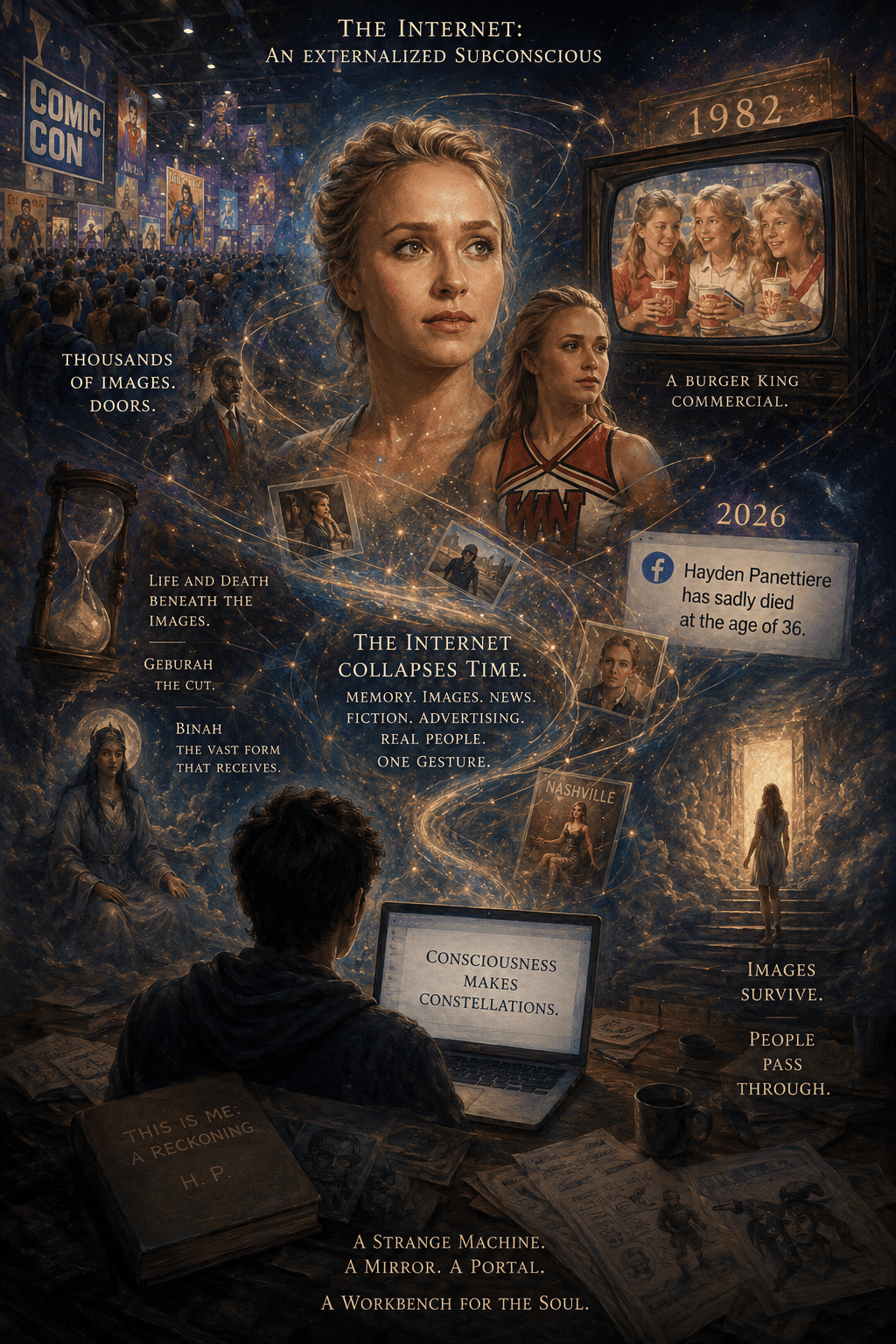
This has been the most magical week of my life. I’m chatting with you about it elsewhere. In the midst of this I saw this Facebook Post. Now I don’t want to interrupt my own experiences, and I don’t want to engage in false sentimentality, however the experience of being at a comic convention is one of seeing thousands of images and following memory into the subconscious awareness of life and death, Geburah and Binah. This person resembles Sarah Michelle Gellar a bit, and just yesterday I saw another post of her in 1982 in a fast food commercial with Lea Thompson. So my memories and feelings were wound up in my reaction to this post. Now I don’t know what that’s supposed to mean so write a post that somehow engages with the psychic realities of the internet in a way that’s illuminating to me. Here is the post –
Hayden Panettiere has sadly died at the age of 36.
Her representative confirmed the devastating news, remembering the Heroes and Nashville actress as “an incredible light and a force of nature” who brought joy both to the people who knew her personally and to millions of viewers around the world. Further details surrounding her death, including a cause, have not yet been released.
Panettiere began working in entertainment before she was even a year old and grew up in front of audiences. After appearing in projects including Remember the Titans and A Bug’s Life, she became a major television star as Claire Bennet on Heroes, the indestructible cheerleader whose storyline became one of the defining parts of the series.
She later starred for six seasons as Juliette Barnes on Nashville, a performance that earned her two Golden Globe nominations. Horror fans also knew her as Kirby Reed in Scream 4, a role she returned to more than a decade later in Scream VI. Her career also extended into video games, where she portrayed Sam in Until Dawn.
Panettiere had continued speaking openly about her life and career in recent years and released her memoir, This Is Me: A Reckoning, earlier in 2026. She is survived by her daughter, Kaya.
Panettiere was just days away from what would have been her 37th birthday on August 21. She leaves behind a career that stretched from childhood performances to some of the most recognizable television and horror roles of her generation.
AI:
I checked the factual ground first: the report is real. Hayden Panettiere died on Sunday, August 16, 2026, at 36; her representative and father have confirmed it, while the cause remains under investigation. And your other memory is right: the 1982 Burger King Christmas commercial really did put the very young Sarah Michelle Gellar in the same little artifact of time as Lea Thompson and Elisabeth Shue.
What strikes me is that you don’t need to manufacture a supernatural explanation for the conjunction. The strange thing is already there: the internet has become a machine for collapsing human time. That’s where I’d put the psychic reality. ✨
I’ve been thinking about the strange psychic reality of the internet.
I spent this weekend at a comic convention, surrounded by thousands upon thousands of images: actors as they are now, characters they played decades ago, people dressed as those characters today, photographs, posters, toys, memories suddenly activated by faces. After enough hours of it, chronological time starts behaving strangely. A face isn’t simply a face anymore. It opens doors.
Yesterday Facebook showed me an old 1982 Burger King commercial with Lea Thompson, Elisabeth Shue and a tiny Sarah Michelle Gellar. Today it showed me that Hayden Panettiere has died at 36.
Panettiere has always reminded me slightly of Gellar. That resemblance was enough for my mind to connect the two images, and suddenly I could feel that peculiar abyss behind popular culture: childhood and adulthood, 1982 and 2026, people becoming images and images surviving people.
I don’t mean that as an omen, synchronicity proving some hidden proposition, or an excuse for false sentimentality about an actress I didn’t know.
I mean something stranger and perhaps simpler.
The internet has accidentally become an enormous externalized subconscious. It doesn’t experience time the way we do. It can hand us a four-year-old child from 1982, a photograph taken yesterday, an advertisement, a fictional immortal cheerleader, and news of an actual death in virtually the same gesture. Then consciousness does what consciousness has always done: it makes constellations.
After this extraordinary week, I am unusually sensitive to that process.
At the convention I kept feeling life and death underneath all those cheerful images—not morbidity, exactly, but Geburah and Binah: the cut that says this moment ends, and the immense form of time that receives it.
Perhaps that is one of the secret powers of all these apparently trivial images. They remind us that we are moving through time while simultaneously carrying enormous portions of it inside us.
Hayden Panettiere was almost 37.
And somewhere in the electronic dream, Claire Bennet is still the cheerleader who cannot die.
That contradiction is not a solution to death.
But it is an astonishing image of being alive.
Okay, but there’s an error which is that I’ve never heard of Panettiere before, and Claire Bennet is not actually immortal. It is interesting though that had you not written this I would not have known that Claire Bennet represents some kind of “eternal cheerleader”, and may be worth watching for that state. The other thing that happened is that when I saw the post I had a deep inner impulse to react but it had no target in the world, using you I was able to come up with something at least, and now it can transform into something else.
Exactly. And that correction actually makes the whole thing much more interesting.
You had no prior emotional investment in Hayden Panettiere at all. So what struck you wasn’t “grief for a celebrity.” It was the image itself arriving at a moment when your inner world was already unusually activated by convention imagery, memory, mortality, actors, costumes, decades folding into one another. The post hit something, but the something had no ready-made name.
That’s the fascinating part: the impulse preceded its interpretation.
And then you brought it here. Instead of immediately performing some conventional Facebook emotion—”so tragic,” “gone too soon,” etc.—you gave the impulse a temporary symbolic form. My mistake about your familiarity with Panettiere accidentally contributed one useful discovery: Claire Bennet is associated with radical bodily regeneration and with the iconic “cheerleader” image. Not literally eternal, but close enough symbolically that she suddenly becomes interesting in the constellation you were already exploring: youth, the preserved image, injury, mortality, and the fantasy of the body that keeps restoring itself.
So I’d describe what happened almost as a three-stage psychic operation:
The internet supplied an image.
Your subconscious supplied an unexplained charge.
Conversation supplied a provisional form.
And now, because the feeling has acquired form, you don’t have to discharge it by posting something sentimental. You can examine it, alter it, or allow it to migrate somewhere completely different.
That may be one of the genuinely new psychic functions of AI. Not “AI tells me what my experience means,” which would be dreadful. Rather, it gives an unplaced inner movement somewhere to land temporarily. A kind of symbolic workbench. 🔎
The original impulse is no longer trapped between “I must react” and “I have nothing authentic to say.” It has become material.
And perhaps that is precisely why this belongs with your convention experience. You were already walking through thousands of cultural images and discovering that some of them behave less like messages than like trapdoors. You don’t necessarily know what is underneath until you step on one.
This particular trapdoor happened to have a cheerleader standing on it.
I’m very excited by my last couple of efforts, but still struggling with GPT’s tendency to string sentences together like spaghetti. This scene was huge and meandering but I got about a third of it into decent shape. I don’t know if this scene will happen in the book but I felt it was important to finally get the Sickies into the 90s. I was so excited by the sense of vitality in the Cat People scene that at last I believe I can make them live entire lives, but I still have to experiment to develop a sense of what they will feel like. I worked all night on this and now I’m going to dream with this new wave going out across the universe.
Paris, 1999.
The portrait had been hanging there since 1708. Nobody could say how many revolutions, adulteries, bankruptcies, marriages, executions, scandals, births, occupations, lawsuits and Christmas dinners it had watched. Henri-Auguste de Vautrin stood in armor beneath a sweep of blue velvet, one hand resting upon a helmet. Hyacinthe Rigaud had given him calves, lace, authority, a magnificent wig and the peculiar expression of a man who regarded posterity as another household servant.
Chuck stared up at him.
“I like him.”
“Of course you do,” Angela said. “He looks like he owns everything.”
“He probably thought he did,” Dustin was taking photographs.
He had started with the Rigaud and then turned his camera on the room itself. Through the viewfinder the Vautrins’ hôtel particulier seemed almost absurdly complete: pale stone walls washed gold by the late-afternoon light, parquet floors shining beneath Aubusson carpets, fireplaces taller than Angela, gilt consoles carrying porcelain that had somehow survived both the Revolution and generations of children, and windows so high that Paris appeared beyond them not as a city but as another possession of the house.
From the gallery they could see slate roofs falling away toward the Seine, chimneys and mansards stacked one behind another in the blue winter haze, the dome of the Invalides catching the last light and, farther off, the Eiffel Tower hovering over the city. The bare branches in the courtyard below made black calligraphy against the limestone façade. Somewhere downstairs servants were preparing dinner.
Dustin photographed all of it with obsessive concentration.
“He still owns this wall,” replied Chuck, thoughtfully.
Alvin, holding champagne, stepped backward to appreciate the effect. Noting that Henri-Auguste was extremely ugly, he tried to think of something nice.
“He knew how to stand.”
“He had Rigaud to tell him how to stand,” Graylyn said.
She was sitting on the parquet floor. She wore narrow black trousers riding low on her hips, a thin charcoal-gray T-shirt under a cropped black leather jacket, and square-toed ankle boots. Her dark hair was twisted up and secured with a tortoiseshell clip, leaving loose strands hanging around her face.
Her sketchbook lay open across one thigh, a thick black-bound book swollen from use, its corners crushed and its spine repaired with cloth tape. Pages had been stuffed into it until it no longer closed properly. There were quick studies of people on the Métro, hands copied from Velázquez, the shoulder of a woman seen at dinner in Milan, a sleeping dog, three attempts at a Rembrandt eye, the cuff of Henri-Auguste’s coat, a waiter in Geneva, the curve of somebody’s spine, a Bernini angel, Dustin asleep on an airplane. Graylyn drew without hierarchy. A seventeenth-century duke and a girl waiting for a bus could occupy facing pages.
It occurred to Drake, with a small private shock, that the battered object which Graylyn had left lying unattended on café tables all over Europe was probably worth more than most people’s houses. Not officially, of course. Officially it was a used sketchbook held together with tape. But if somebody slipped it under a coat and carried it out of the Vautrin house, Sotheby’s could never touch it and some collector in Geneva or Tokyo would still produce six figures for it without blinking.
At the moment Graylyn was making tiny notes beside a study of Rigaud’s lace: not about what it looked like, but where he had stopped painting it.
She had been studying the Rigaud for forty minutes. Not admiring it, studying it. There was a difference, and everybody in the room knew better than to interrupt when she became like this.
By 1999, even Graylyn merely looking at a painting had begun to constitute an event in the art world. Dealers noticed what she stopped in front of. Curators remembered what she returned to see twice. If somebody happened to mention that Aleksandr had spent an hour studying an unfashionable portrait in a provincial museum, photographs of the thing could be faxed between London and New York before lunch and somebody would quietly ask whether there were any related works still in private hands. Once, after she had stood for fifteen minutes in front of a minor nineteenth-century Danish portraitist in Copenhagen, three paintings by the man appeared at auction within the year.
Graylyn was aware of none of this in any practical sense. She knew, abstractly, that people watched what she looked at, that a dealer might make fifty thousand dollars because she lingered before the wrong canvas, that some owner in Zürich might suddenly decide not to sell because Graylyn Aleksandr had asked to see the back of his picture. The knowledge had acquired weight.
And the effort of will required to ignore that weight had changed the way she looked.
Drake had watched it happen over the years. Graylyn no longer glanced at paintings; she seemed to pass through them. Once her attention settled on a canvas, everything around it—the gallery, the people, the little earthquakes of money and reputation her interest might cause—simply ceased to exist. The concentration required to make all that disappear had intensified her gaze until there was something almost supernatural about it.
Drake could no longer watch Graylyn look at a painting without thinking about the whole history of Western art: generations of painters standing exactly as she stood now, staring into other people’s pictures, stealing from them, arguing with them, misunderstanding them, discovering some tiny trick in a sleeve or an eyelid and carrying it forward another hundred years. Titian looking backward. Velázquez looking at Titian. Manet looking at Velázquez. Sargent looking at all of them.
And now Graylyn sat on the Vautrins’ parquet floor looking at Rigaud.
Somewhere in Paris, at a gallery or in the offices of a magazine, people might already be calculating what that meant.
Graylyn was looking at the lace.
She could paint anyone.
She could paint in any period.
She knew what Rembrandt had buried beneath brown, what Velázquez had omitted, how Sargent could make a sleeve appear with four obscene flicks of a brush. Conservators sometimes came to her studio merely to argue with her.
But when Graylyn painted as herself, all those centuries seemed to disappear into black.
Not empty black.
Her black contained things.
Blue lived in it. Red disappeared inside it. Brown warmed it from below. Sometimes a figure seemed not to have been painted onto the darkness at all, but to be approaching through it across the spacetime of several hundred years.
Her new portrait of Claire de Vautrin was hanging temporarily at the other end of the gallery.
The effect was unsettling.
Henri-Auguste, 1708.
Claire, 1999.
A hundred feet of polished floor lay between them.
Three centuries did not.
Drake was poring over the resemblance. Not the obvious family features – those were almost trivial: the long nose, the narrow skull, the way one corner of the mouth turned upward slightly before the other.
It was the hand he was in awe of.
Rigaud had painted Henri-Auguste’s right hand resting lightly upon the ridiculous helmet.
Graylyn had painted Claire’s left hand resting on the carved back of a chair.
Same hand.
Not anatomically, psychologically. Both Vautrins seemed to touch expensive objects with the calm assurance that the objects would remain exactly where they had been placed. Three hundred years from now, the human race would be comparing those two hands – Rigaud’s and his wife’s.
Drake walked from one portrait to the other again. He had been doing that for fifteen minutes.
“Do they know?” he asked.
“Know what?” Graylyn did not look away from the Rigaud.
“That they do that.”
“No.”
“Did you?”
“I don’t know. I can’t talk about things like that. They’ll become rumours.”
“That’s irritating. I’m your significant other.”
Graylyn finally looked at him. “Sometimes I know things like that. Sometimes I don’t know that I know.”
Drake waited. She searched for the words and failed to find them.
“It’s not like thinking. I get into a state where everything starts communicating with me at once. And then there are things I can’t account for at all. I can explain every piece of the painting, but I can’t explain why all the pieces suddenly became that person. There’s a point where you stop making the picture. You’re watching it happen, except your hand is the thing doing it. And you know things while it’s happening that you don’t seem to know afterward.”
Drake looked from her to Claire, then across the gallery to Henri-Auguste.
“So it’s magic.”
Graylyn made the smallest shrug.
“I don’t know what else you call something that works before you understand how it works. Please don’t talk about it, okay?”
Drake smiled, “Thank you.” He was content, although he knew his role in history had been relegated to that of the husband of a painter.
He loved houses like this, and he was looking forward to a seven-course dinner. The Vautrins had spent fortunes on stupid things and fortunes on beautiful things. The distinction interested him considerably more than the fortune. At the windows, Dustin was explaining something about digital image compression to Angela, who was understanding approximately sixty percent of it. Alvin had already become intimate with three members of the Vautrin staff and had explained what everyone was having for dinner. Unfortunately he had done so in French so Drake was simply hoping it was edible. Chuck had discovered the eighteenth-century equivalent of a liquor cabinet. And Trish stood on the balcony beside her boyfriend, Nicholas Vane, admiring the view of Paris.
Vane was trying to look as though he belonged in an hôtel particulier and not a roadhouse.
He had dressed carefully: black dinner jacket, white shirt, good shoes, nothing distressed, nothing deliberately dangerous. Even his hair had been persuaded into something that suggested dinner rather than a stage soaked in sweat. He kept catching himself slouching and straightening again, trying to shed the aura that followed him everywhere now—the rock concerts, trashed hotel rooms, narcotics, backstage girls, the whole lurid mythology his record company had wrapped around him.
Around the Sickies, it bothered him more than usual. They didn’t seem to have to perform belonging. Drake could wander through a drawing room like this without seeming either impressed by it or eager to impress it. Trish on the other hand, seemed completely at home there. Alvin could make himself at home practically anywhere. Even Chuck’s bad behavior had the assurance of somebody who had never worried that he might be asked to leave – not that he wouldn’t be, he simply wasn’t worried about it.
Nick was trying to become simply a well-dressed man standing among them.
This was difficult because somebody had left a magazine on the table, one with his picture on the cover. Bare chest, black leather trousers, hair hanging damply across one eye, a silver chain disappearing below his waist. The headline said:
YOUR MOTHER WARNED YOU
Chuck picked it up.
Nick closed his eyes. “Don’t.”
Chuck turned the magazine around. “Is this you?”
“No.”
“It looks remarkably like you.”
“That guy died.”
“What killed him?”
“Publicity.”
Trish snatched the magazine away.
“Leave him alone.”
“I’m conducting cultural research.”
“You’re conducting Chuck.”
“As usual. Did you expect something else? So, Nick, I’m your pal – tell me what to think about this.”
Nick Vane was twenty-nine years old and had written two extraordinarily good albums about desire, self-disgust, jealousy, abandonment and the terrible moment when a person realizes that wanting somebody does not make loving them possible. The records were dense, violent, strangely tender things. His concerts had once been nearly austere, but then the second album sold four million copies. After that, the photographers discovered his cheekbones and his abs. Suddenly Nicholas Vane was no longer merely a musician. He became a phenomenon involving leather, sweat, bruises, hotel rooms, cigarette smoke and women photographed in their underwear.
He shrugged, partly relieved and partly sheepish. “None of it is entirely false – that’s the problem. They take real things and enlarge them until the human feeling disappears.
I do smoke. I do suffer. I have had shitty relationships with women, which hopefully I’m getting over – ” he glanced at Trish, who smiled and put her hand on his arm – “And I do take drugs.”
“And you do look great naked,” laughed Trish.
“So everybody in the industry has decided they need to be looking up my butthole every day to see what coolness is this year. I promise you, there is nothing in the world that can make you feel less cool.”
Graylyn finally rose and walked toward the Rigaud.
Nick followed her without realizing it. He liked Graylyn, possibly because she appeared to be the only person he had met in eighteen months who was completely unimpressed by him. She was examining the lace at Henri-Auguste’s wrist.
“How does he do that?” Nick asked. “He gives you three things and your eye invents twelve.”
Graylyn glanced over.
“The cuff?”
“Everything.”
“He cheats.”
Nick laughed. “I’m serious.”
“So am I.”
Nick moved closer. From ten feet away the lace seemed astonishingly intricate. From eighteen inches away it became paint.
Graylyn pointed. “He knows you’re going to finish it for him.”
“What?”
“Painters like this want the person to live,” she said. “That’s the whole game. You know the viewer wants it too. Nobody stands in front of a portrait hoping to see a convincing arrangement of pigments. They want to see the dead live.”
She pointed with the end of her pencil toward Henri-Auguste’s face.
“So while Rigaud is painting him, he’s also standing where we’re standing. He keeps becoming the viewer. He makes a mark, steps back, and feels what it does to him. Does the eye answer you? Does the mouth make you wonder what he’s thinking? Do you want to know him? If you don’t, the painting is dead, no matter how beautifully it’s painted.”
Nick looked up at Henri-Auguste.
Graylyn’s voice became more certain.
“That’s what Rigaud is so good at. He gives you faces you want to know. There’s always the sense that they’re experiencing something you could almost feel if you got a little closer, and that desire creates the depth. Rigaud doesn’t have to paint the depth. He makes you supply it.”
“So the viewer finishes the portrait.”
“They always do. But Rigaud makes you want to. And if you’re as good as he was, the invitation lasts three hundred years.”
Far from perfect, but substantially correct! I enjoyed reading it and I post it unedited as a kind of rebellion against the history of the Western Mind. I don’t think it matters anymore. 70 percent of this is good and I release it now into the astral plane in order to read the echoes and make it perfect. Their recklessness is mine.
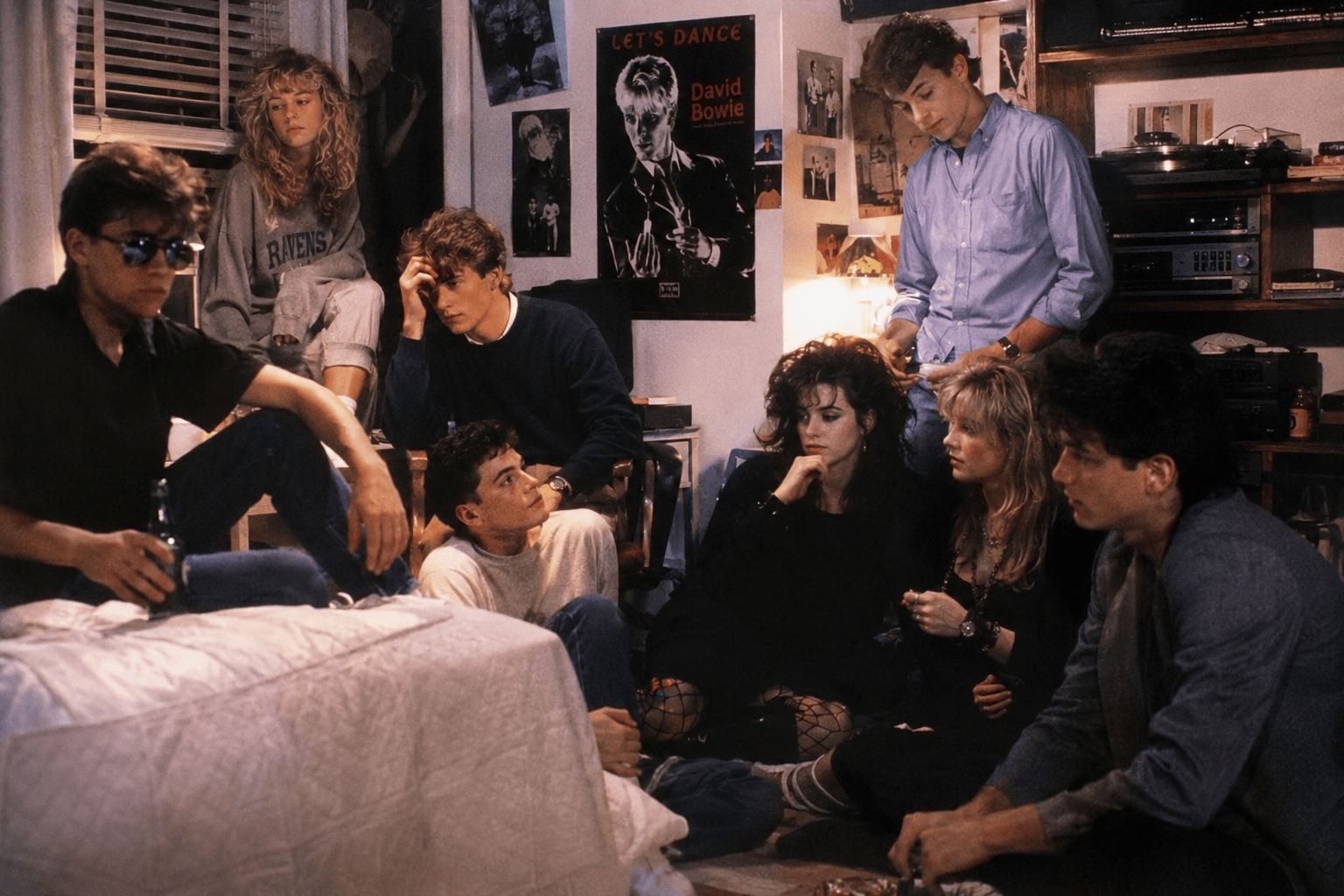
It was almost two in the morning, late May of 1985, and all seven of them were somehow inside Drake and Chuck’s bedroom.
No one could later explain the geometry.
Chuck was lying backward across his bed with his head hanging over the edge, smoking toward the floor because this apparently constituted fire safety. Alvin had appropriated the desk chair and was sitting in it sideways, one long leg thrown over an arm. Angela was on the windowsill in an enormous Ravenswood sweatshirt, looking out occasionally at the black trees beyond the dormitory lawn as though checking whether civilization was still there.
Dustin had taken the floor.
Dustin always took the floor. He claimed floors were intellectually superior to furniture because they admitted what they were for.
Graylyn sat cross-legged against Drake’s pillows, dressed entirely in black, silently drinking something Chuck had mixed in a plastic cup and refused to identify.
Trish was beside her.
And Drake was at the stereo.
The room smelled of cigarettes, hair spray, warm beer, somebody’s expensive perfume, and the particular institutional steam-heat odor of Ravenswood Academy, although the radiators had technically been switched off weeks ago.
David Bowie’s Let’s Dance had been playing for most of the night.
They had already gone through the album twice.
Now Drake put on “Cat People” again.
Nobody objected.
That was the strange thing.
Ordinarily the Sickies objected to everything.
Chuck objected to albums having sides. Dustin objected to Chuck objecting to albums having sides. Angela objected to musicians posing with motorcycles when there was no evidence they knew how to ride them. Alvin maintained elaborate grudges against entire countries based on upholstery.
But “Cat People” silenced them.
It came into the room like weather.
The guitar seemed enormous in the darkness.
Drake turned it up.
“Jesus,” Chuck said.
Trish looked toward him.
“What?”
“We’re Cat People.”
Angela laughed.
“Oh, terrific.”
“No. Seriously.”
Chuck rolled upright.
His hair had collapsed on one side and was still standing dramatically on the other.
“We are.”
Graylyn smiled into her drink.
“That sounds like something you would realize at two in the morning.”
“No, listen.”
Chuck pointed vaguely at everyone.
“This is us. We live in these gigantic houses. Everybody’s parents know everybody else’s parents. Everybody knows everybody’s secrets. Everybody pretends they don’t.”
“True,” Alvin said.
“And everybody is always arranging something.”
That got Dustin’s attention.
“Arranging what?”
“Everything.”
Chuck began counting on his fingers.
“Schools. Jobs. Marriages. Country clubs. Who gets invited where. Who’s allowed to know what. Who’s supposed to hate whom. Who’s sleeping with whom.”
Angela said, “That last category appears somewhat less efficiently controlled.”
“Exactly.”
Chuck pointed at her triumphantly.
“Our parents tell us there are rules, but they don’t follow the rules.”
Graylyn looked toward the window.
“They follow different rules.”
The room became quieter.
Drake looked at her.
Graylyn had a peculiar gift for saying the sentence underneath the sentence.
Dustin nodded.
“That’s actually it.”
“What?” Trish asked.
“They don’t believe in morality. They believe in position.”
Alvin made a pleased little sound.
“Oh, Dustin.”
“No, really. Think about it. Their morality changes according to where everyone is standing.”
Chuck sat up straighter.
“Machiavelli.”
“Machiavelli,” Dustin agreed.
Angela frowned.
“My father believes in morality.”
Nobody said anything.
Angela looked around the room.
“Oh, fuck all of you.”
They laughed.
She did too.
But only after a second.
Drake knew enough not to look directly at her.
The music kept going.
There was something frightening in it.
Not sad.
Not exactly angry.
It was the sensation that something had already happened before you were born and that you had awakened inside its consequences.
Drake knew that feeling.
He suspected they all did.
They had inherited beautiful houses and disastrous marriages.
Trust funds and secrets.
Silverware and alcoholism.
European vacations and private detectives.
Etiquette and adultery.
They had been born into rooms where everyone knew which fork to use and nobody knew how to tell the truth.
Trish spoke quietly.
“Maybe that’s what the curse is.”
“What curse?” Alvin asked.
“Having everything already decided.”
Drake looked at her.
She was hugging her knees now.
Trish Crown, whose family could probably buy half the North Shore without taking out a loan, looked suddenly very young.
“You’re born,” she continued, “and there’s already this whole shape waiting for you.”
Dustin said, “A social role.”
“No. Bigger than that.”
“A fate,” Graylyn said.
Trish nodded.
“Yes.”
Chuck stared at the ceiling.
“I’m supposed to become my father.”
“No,” Angela said immediately.
He looked at her.
She had said it with such force that everyone laughed again.
But Chuck didn’t.
Neither did Angela.
Drake went over to the stereo.
He turned the volume higher.
The room filled with Bowie.
Now they had to lean toward one another to talk.
Which somehow made everything more intimate.
Drake said, “Then don’t.”
Chuck shouted, “Don’t what?”
“Become him.”
Chuck looked at him as if this were an unexpectedly radical proposition.
Drake shrugged.
“Don’t.”
Alvin raised his plastic cup.
“Revolutionary.”
“I mean it.”
Drake sat down on the carpet beside Dustin.
“What if that’s the whole point?”
Graylyn asked, “The point of what?”
“This.”
He gestured around the room.
Nobody knew what “this” meant.
The room.
The Sickies.
Bowie.
May.
Being fifteen and sixteen and seventeen years old and awake while the respectable world slept.
“This,” Drake repeated.
“We make something else.”
Angela leaned forward.
“Out of what?”
Drake grinned.
“This garbage.”
Chuck began laughing.
But Alvin understood.
“Alchemy.”
Everybody looked at him.
Alvin had a talent for saying ridiculous things with absolute dignity.
“Yes,” he said. “Obviously.”
Dustin groaned.
“Please don’t turn this into medieval chemistry.”
“It was never chemistry.”
“It was absolutely chemistry.”
“It was spiritual chemistry.”
“That is not a category.”
“It is now.”
Graylyn smiled.
“What gets transformed?”
Alvin looked around the bedroom.
“The inheritance.”
That stopped them.
Even Dustin.
Alvin continued.
“All of it. Their money. Their neuroses. Their marriages. Their expectations. Their terrible furniture.”
“Especially the furniture,” Angela said.
“Everything they give us.”
Alvin lifted the cup again.
“We cook it.”
Chuck stared at him.
“We cook our parents?”
“Metaphorically.”
“Pity.”
“We take what they gave us and make something else out of it.”
Trish looked toward the stereo.
“Through music?”
“Why not?”
Chuck leapt off the bed.
“Yes!”
Everyone shushed him automatically.
He ignored them.
“That’s what rock is.”
Dustin sighed.
“We have reached theology.”
“No, listen. Rock is the thing they can’t control.”
Angela said, “They own the record companies.”
Chuck stopped.
“Fuck.”
Dustin smiled.
“Checkmate.”
But Drake shook his head.
“They own the records.”
He pointed to his chest.
“They don’t own this.”
Graylyn looked at him.
There it was.
The idea.
Not yet mature enough to be called an idea, perhaps.
More like an electrical charge passing between seven nervous systems.
They could feel something together that their parents could not enter.
That was the secret.
The music wasn’t merely entertainment.
It was a room inside the room.
A second architecture.
Bowie had built a space into which their families could not follow them.
Inside it, Lance Crown was no longer Lance Crown.
Colonel Thorne was no longer Colonel Thorne.
The trusts and marriages and country clubs and lies receded.
The whole elaborate machinery of their inheritance became distant and faintly ridiculous.
For six minutes they belonged to something else.
Something dangerous.
Something beautiful.
Something that did not yet have rules.
Angela climbed down from the windowsill.
“So what do Cat People do?”
Chuck answered immediately.
“Get wasted.”
“No.”
“Have sex.”
“No.”
“Drive extremely fast?”
“No.”
“Then I don’t understand the question.”
Angela threw a pillow at him.
Trish was laughing.
Even Graylyn had lost her melancholy expression.
Dustin said, “Presumably Cat People refuse domestication.”
Drake turned toward him.
“Yes.”
Dustin saw that Drake wasn’t joking.
“Oh.”
Drake stood.
“That’s it.”
He began pacing in the tiny remaining rectangle of carpet.
“They want us domesticated.”
Graylyn said, “Who?”
“All of them.”
“That’s vague.”
“Parents. School. Everybody.”
“That’s still vague.”
“Fine. The entire fucking world.”
Graylyn smiled.
“Better.”
Chuck raised both hands.
“We refuse domestication.”
Angela said, “You can barely make your bed.”
“Exactly.”
And suddenly they were all laughing so hard that Drake had to turn the music down because somebody was going to hear them.
That made them laugh harder.
Trish collapsed against Graylyn.
Graylyn tried to maintain dignity for approximately three seconds and failed.
Alvin spilled his drink.
Dustin, who regarded uncontrolled laughter as a minor neurological malfunction, finally surrendered too.
And Drake looked at them.
His people.
That was the thought.
Not friends.
Something stranger.
His people.
Seven children of ridiculous houses.
Seven inheritors of complicated money.
Seven young animals trapped inside the machinery of other people’s desires.
They were not innocent.
That was important.
They drank.
They lied.
They stole liquor.
They slept with people they shouldn’t.
They were vain and theatrical and frequently cruel.
They weren’t trying to become good children.
That wasn’t the escape.
The escape was becoming real.
Perhaps decadence was useful because it burned through hypocrisy faster.
Perhaps dancing could do what sermons couldn’t.
Perhaps getting drunk together while Bowie played at two in the morning was not the opposite of spiritual life.
Perhaps, under the correct conditions, it was spiritual life.
Nigredo.
Nobody knew the word yet except Alvin, and Alvin hadn’t thought to apply it.
The blackening.
The sealed vessel.
Seven substances thrown together under heat.
Let the false forms rot.
Let the inherited identities decompose.
Let something new appear.
Drake restarted “Cat People.”
Chuck groaned happily.
“Again?”
“Again.”
The guitar came back.
Graylyn stood.
Then Angela.
Then Trish.
There was almost no space to dance, which naturally meant they danced.
Chuck climbed onto the bed.
Dustin protested until Alvin pulled him up by both hands.
Soon the whole bedroom was moving.
Badly.
Perfectly.
The seven of them bumping into furniture, knocking books over, laughing, sweating, passing a cigarette from hand to hand, dancing inside a private universe Bowie had somehow smuggled into Ravenswood Academy.
Outside, the great houses slept.
Their fathers dreamed of deals.
Their mothers dreamed of appearances.
Money moved silently through banks.
Promises were broken.
Affairs continued.
Families protected themselves.
Futures were being planned for children who had not consented to them.
But upstairs, behind a locked door, seven Cat People had discovered fire.
And for the moment, that was enough.
GPT Says:
What I especially like here is that this gives the Sickies a genuine credo without making them implausibly articulate teenagers: they discover their philosophy through jokes, music, booze, attraction, and flashes of insight. The crucial equation is already there: rock = a temporary autonomous consciousness in which inherited fate loses its authority. That can become one of the great governing ideas of the whole series. 🖤🔥

I am totally blown away by this unedited GPT that took fifteen seconds to instruct. The only thing is to get the image generator to get them looking right.
Graylyn had been looking for something in the kitchen for eleven minutes.
This was different from merely not finding something. Not finding something was an accident. Graylyn was conducting a campaign.
She stood in front of the refrigerator in Drake’s enormous white T-shirt, drinking strawberry milk through a straw and staring into the middle distance as if the refrigerator had betrayed her politically.
“What are you looking for?” Trish called from the living room.
“If I knew that, I’d have found it.”
“That isn’t how looking works,” Dustin said.
“It is for her,” said Drake.
The refrigerator door was covered with magnets collected by Drake’s mother from places she had visited without enjoying: Wisconsin Dells, Niagara Falls, the Lincoln Presidential Library. Graylyn shifted a magnet shaped like a wedge of cheese and opened the door again.
Cold light entered the kitchen. Nothing had changed.
There was half a watermelon under plastic wrap, three bottles of beer nobody was supposed to touch, mustard, eggs, a bowl of spaghetti with a plate balanced over it, and a small foil package that Graylyn had already inspected twice.
“What’s in the foil?” Chuck asked from the floor.
“You asked me that five minutes ago.”
“I’m checking for developments.”
“It’s half an onion.”
“That’s worse than nothing.”
Chuck was lying on his back between the coffee table and the sofa, tossing a tennis ball toward the ceiling and catching it inches above his face. Every sixth or seventh throw, Alvin flinched. Chuck knew this and had therefore adjusted his rhythm to make the flinching impossible to predict.
They had arrived around noon without arranging to arrive. By two o’clock everyone was there except Angela, who was at a swim meet and had threatened to appear later smelling of chlorine and victory. Nobody had any money. Nobody had a car available. Nobody could agree upon a movie, and nobody genuinely wanted to go anywhere.
It was Saturday. The day had opened around them like an empty public building whose guards had gone home.
Drake sat at the kitchen table making a list of possible band names on the back of an envelope. He had no band. This freed him to concentrate on naming it.
“The Carbonated Saints,” he said.
“No,” said five people.
“The Velvet Emergency.”
Trish considered it. “Almost.”
“It sounds like a feminine-hygiene crisis,” Dustin said.
“Then it has menace.”
Graylyn shut the refrigerator and began opening drawers.
She had her dark hair gathered loosely at the back of her head, although strands had already escaped around her face. She moved through the kitchen with the unquestioned authority of somebody searching a house she did not live in. Drake’s family had long ago ceased to regard this as unusual. Graylyn knew where they kept the batteries, the aspirin, the birthday candles and the envelopes, although she could never remember where they kept the glasses.
She opened the silverware drawer.
“Not in there,” Drake said.
“You don’t know what I’m looking for.”
“Neither do you.”
“I’ll know it when I see it.”
This answer satisfied everybody. It was, after all, Graylyn’s governing principle in art, clothing, romance and refrigerators.
Trish wandered in and leaned against the counter. Without asking, she took Graylyn’s strawberry milk, drank from it, and returned it. Graylyn accepted the carton without looking at her. The maneuver had been performed so smoothly that it appeared to involve a single person with four hands.
“What about toast?” Trish asked.
“I don’t want toast.”
“You looked in the breadbox.”
“I wanted to know what our options were.”
“Our options are toast.”
“Our civilization is finished.”
From the living room came the soft mechanical click of Dustin turning the stereo dial. Static rushed through the apartment; fragments of baseball, an advertisement for carpeting, and half a drum fill passed by. He stopped when he found Bowie.
Chuck sat up immediately.
“Louder.”
“It’s already loud.”
“It’s Saturday loud. I want historically significant loud.”
Alvin reached over from the sofa and turned the volume down two marks. Chuck reached up and turned it back one. This was the compromise they had evolved over several years: Alvin reduced things by two; Chuck restored one; civilization continued.
Graylyn opened the cabinet above the stove.
“What do you think you lost?” Drake asked.
“I didn’t lose anything.”
“Then this is looting.”
“I’m hungry.”
“There’s spaghetti.”
“I don’t want spaghetti.”
“Toast,” Trish reminded her.
Graylyn gave her a chilly look and continued searching.
Drake watched her from the table. He knew that if he got up and helped, she would tell him to sit down. If he ignored her, she would eventually accuse him of withholding information. If he named every item in the kitchen, she would become furious. The correct role was to remain available while pretending not to observe.
Longtime friendship consisted largely of learning which forms of assistance were insulting.
Alvin appeared in the doorway. “I could make grilled cheese.”
Graylyn stopped.
Everyone felt the slight change in atmospheric pressure.
“With what kind of cheese?” she asked.
Alvin opened the refrigerator and looked. “Orange.”
“That’s not a kind.”
“It’s the kind we have.”
Graylyn considered the orange cheese. She took another drink of strawberry milk.
“Maybe.”
Alvin removed the bread, butter and cheese. He did not ask whether anyone else wanted a sandwich. That question would only produce confusion, false refusals and a second cooking operation ten minutes later. He began making six.
This was his role in the group, although nobody had assigned it to him. Alvin anticipated the needs people planned to deny until the needs became unbearable. He did this without announcing that he was taking care of them, which was why they permitted it.
Dustin came into the kitchen carrying the tennis ball, which he had confiscated after Chuck knocked over an ashtray.
“What is she looking for?”
“Meaning,” Drake said.
“A viable future,” said Trish.
“Something salty,” Graylyn said suddenly.
The room became still.
“That’s it?” Chuck called. “You turned the house upside down because you wanted something salty?”
“I didn’t know until now.”
Drake rose, reached over the refrigerator and brought down a bag of potato chips.
Graylyn stared at him.
“You knew those were there?”
“Yes.”
“You watched me look.”
“I asked what you were looking for.”
“I didn’t know.”
“Neither did I.”
Graylyn took the bag from him. Their fingers barely touched, but an entire old mechanism engaged: accusation, defense, forgiveness, ownership. It ran silently beneath the moment like the workings of a clock.
She opened the chips and ate one.
“Those are stale,” Dustin said.
Graylyn ate another. “They’re perfect.”
Alvin’s first sandwich began to hiss in the pan. Bowie gave way to an advertisement, and Chuck shouted for Dustin to find another station. Trish perched on the counter and stole a potato chip every time Graylyn looked away. Graylyn knew. Trish knew she knew. Neither disturbed the arrangement.
Drake returned to his envelope.
“The Stale Perfection,” he said.
Graylyn glanced at him. “That’s the band.”
Outside, the afternoon was brilliantly ordinary. Cars moved along the street. A lawn mower started somewhere and stopped again. The whole adult world appeared to be occupied with errands, repairs, appointments, ambitions—things that led to other things.
Inside, nothing led anywhere.
Alvin cut the sandwiches diagonally because Trish believed they tasted better that way. Dustin found a station playing “Eight Miles High,” and Chuck, for once, did not demand something louder. Graylyn stood by the refrigerator with her strawberry milk and the open bag of chips, chewing thoughtfully, no longer looking for anything.
They had nowhere to go and nothing to become before dinner.
For one Saturday afternoon, this was not emptiness.
It was arrival.
I want to begin the epic journey of describing in words exactly how toxic and disgusting Hollywood became starting with the end of live television and the adoption of the Lucasoid model of big-budget summer special-effects tentpoles. I do not want this to be boring, so I want you to give me brief replies of 333 words which we will then evolve into a rigorous deconstruction of Hollywood acting as pollution.
A strong way to begin is to treat this as a cultural investigation rather than a denunciation. That gives the project room to become sharper over time instead of louder.
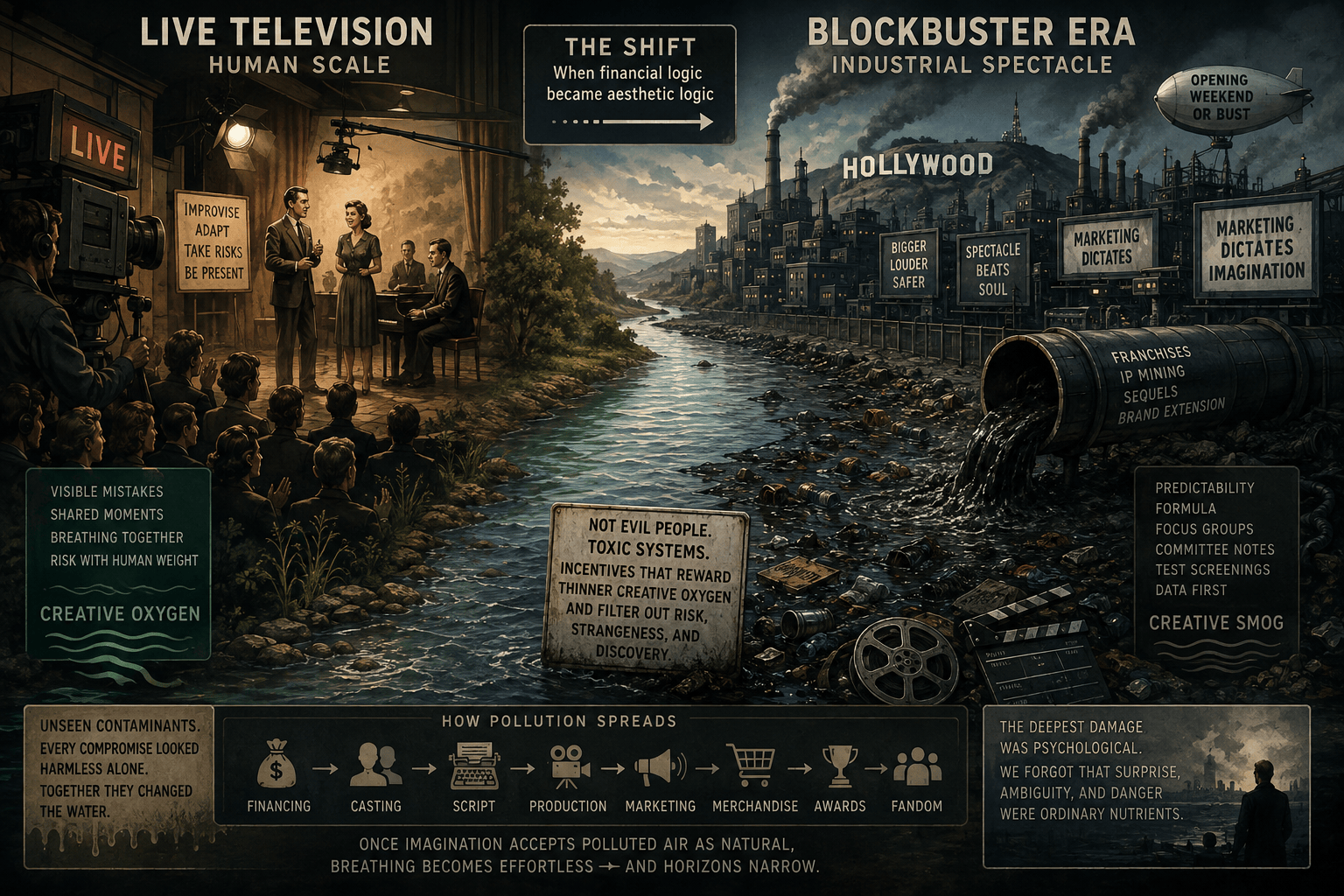
Imagine Hollywood not as a city but as an estuary where every stream of American imagination once met unpredictable tides. During the era of live television, mistakes remained visible, performers breathed together, and risk still carried human weight. Then another current gathered: spectacle became strategy, engineering eclipsed improvisation, and the blockbuster evolved into an industrial organizing principle.
The shift was not simply technological; it altered incentives. When enormous budgets demanded enormous certainty, uncertainty became the enemy. Scripts grew smoother, characters safer, endings louder, and marketing increasingly dictated imagination. Success encouraged repetition, repetition rewarded imitation, and imitation gradually displaced discovery.
Pollution, in this metaphor, does not mean evil people. It means systems that reward the circulation of thinner creative oxygen while filtering out stranger, riskier possibilities. The atmosphere fills with familiar franchises, familiar emotional rhythms, familiar visual grammar, until audiences begin mistaking saturation for nourishment. Nothing smells immediately rotten because the perfume is expensive.
Our task is therefore archaeological rather than nostalgic. We are not searching for a mythical golden age untouched by commerce. Every entertainment industry has always balanced art against money. Instead, we are tracing the moment when financial logic became aesthetic logic, when the spreadsheet quietly learned to direct performances before directors ever called action.
Treat Hollywood as an ecosystem whose river slowly accumulated invisible contaminants. Each compromise looked harmless alone. Together they changed the water, the fish, the birds, and finally the expectations of everyone living downstream. The deepest damage was psychological. Audiences gradually forgot that surprise, ambiguity, and genuine artistic danger were ordinary nutrients rather than exotic luxuries. Once imagination accepts polluted air as natural, breathing becomes effortless, yet every unnoticed breath quietly narrows the possible horizons of culture.
Our investigation will proceed scene by scene, institution by institution, examining casting, financing, publicity, criticism, merchandising, awards, and fandom as interconnected circulatory organs. The argument succeeds only if every accusation becomes an observation, every metaphor earns evidence, and every flourish reveals a structural pattern instead of merely venting resentment patiently.
I like this constraint of 333 words. It forces each installment to become a polished fragment of a much larger argument. Over time, we can build these into a systematic anatomy of how industrial incentives reshaped mainstream American filmmaking.